Why Making Mistakes is Vital for Football Player Development
What if the secret to becoming an elite football player isn't about flawlessly executing every pass, tackle, or shot? What if the path to unparalleled skill and unwavering mental toughness is paved not with perfect performances, but with lessons learned from every misstep on the pitch? The truth is, mistakes are not just inevitable in football player development; they are the most powerful catalysts for growth. They shape a player's journey from raw talent to a refined master of the beautiful game.
Football is dynamic and unpredictable, where errors are a constant companion, from a misplaced pass to a missed tackle. However, viewing these moments as invaluable feedback, not failures, unlocks transformative potential for player development. This shifts focus from perfection to continuous learning. Embracing mistakes accelerates technical mastery, fortifies mental resilience, and achieves highest potential.

Understanding the Transformative Power of Error in Football
Beyond Perfection: The Unrealistic Pursuit of an Error-Free Game
In football, an unspoken expectation for error-free performance often exists, especially among young players. This pursuit of perfection is fundamentally flawed and counterproductive, breeding a fear of failure. It leads players to play safe, avoid creative risks, and stifle their natural talent.
Imagine a midfielder always opting for simple backward passes, avoiding potential turnovers. While this avoids mistakes, it also prevents game-changing plays and true football player development. Growth comes from stepping outside comfort zones, where mistakes increase, but so does potential for significant learning.
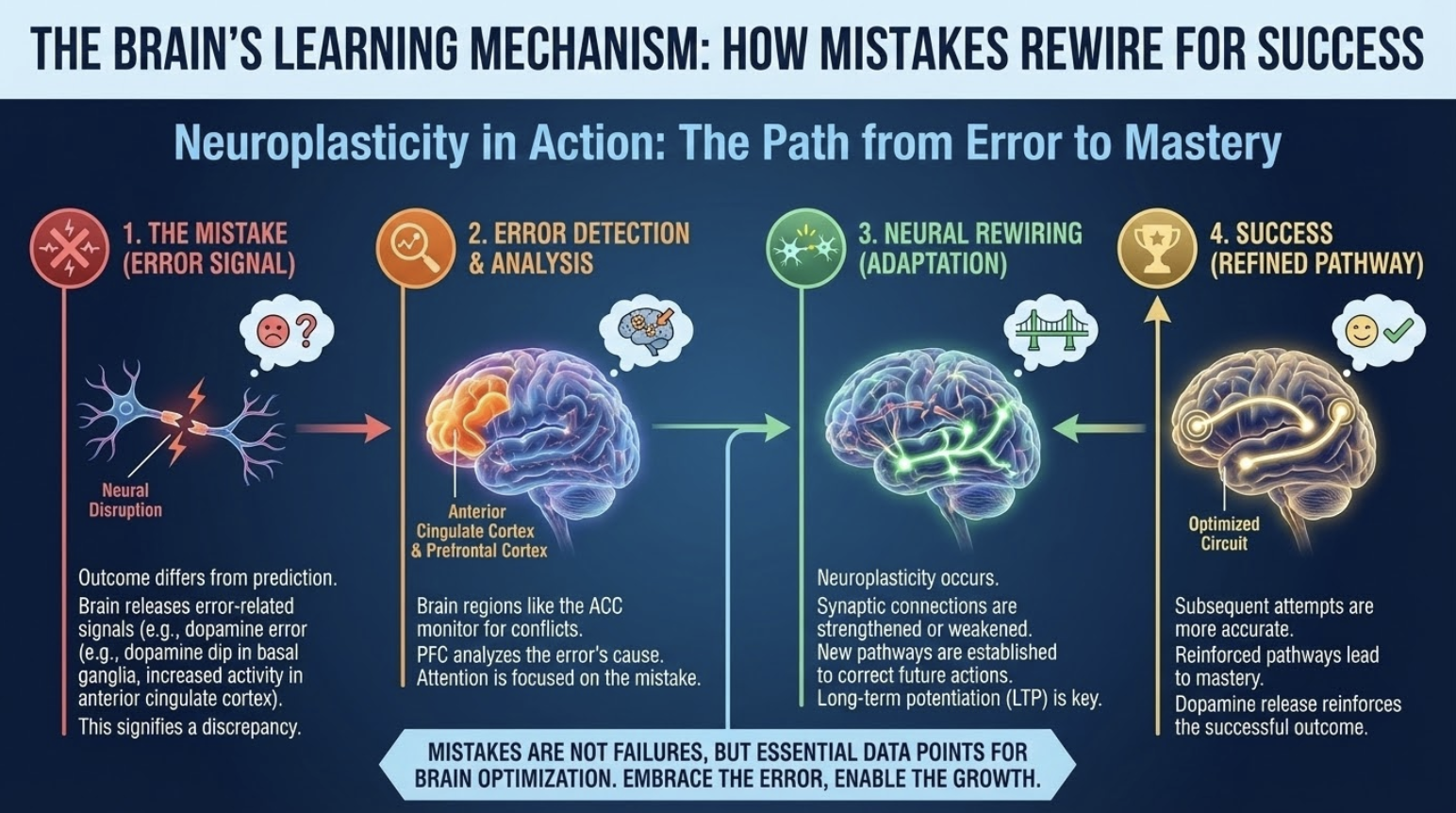
The Brain's Learning Mechanism: How Mistakes Rewire for Success
The human brain excels at learning from errors. When a player makes a mistake, the brain registers a discrepancy, triggering a powerful learning process. Neuroscientists show mistakes, followed by reflection and correction, activate neural pathways to consolidate new information and refine motor skills.
For a striker practicing a shot, each miss provides feedback—wrong body position, off-contact, incomplete follow-through. This feedback loop enables micro-adjustments, rewiring neural connections. This iterative process improves technical skills and tactical decision-making, making mistakes vital data points for improvement.
The Psychological Edge: Building Resilience Through Adversity
Developing Mental Toughness: Bouncing Back from On-Field Blunders
Football is a mental game, demanding exceptional mental toughness from players. This attribute develops not through flawless performances, but by making mistakes and learning to recover from them. Consider a young goalkeeper letting in an easily saveable goal in a crucial match.
A truly resilient player quickly processes the error, acknowledging what went wrong, then mentally "resets" for the next play. This "short memory" for errors, bouncing back with focus, is a hallmark of top performers. Coaches cultivate this by encouraging immediate self-correction and positive self-talk.

Confidence and Risk-Taking: The Courage to Try New Things
Fear of mistakes significantly inhibits a player's potential, leading to conservative play. This cautious approach stifles creativity, limits tactical innovation, and prevents players from discovering true capabilities. A player afraid to attempt a daring through-ball might never realise their potential as a playmaker.
Conversely, an environment where mistakes are accepted fosters confidence and encourages risk-taking. Players feel safe to experiment with ambitious passes or audacious dribbles. Each failure provides invaluable data, teaching about timing, spacing, and opponent reactions. This iterative process builds genuine confidence in their capacity to learn and adapt.
Tactical and Technical Growth: Refining Skills on the Pitch
Learning from Positional Errors: Improving Game Awareness and Strategy
Tactical understanding in football requires constant information processing. Positional errors are common in developing players, offering rich learning opportunities. Imagine a central defender repeatedly out of position, exploiting a gap. This is a tactical lapse, not just technical.
A good coach uses this mistake as a teaching moment, explaining why it was an error and how to correct it. The player learns better spatial awareness, communication cues, and strategic positioning. These insights, forged from game mistakes, are often more impactful than theoretical sessions for football player development.
Perfecting Technical Execution: The Repetition and Correction Cycle
Technical skills in football—passing, shooting, dribbling—are refined through a continuous cycle of repetition and correction, which inherently involves making mistakes. Consider a striker perfecting their finishing, taking hundreds of shots, many of which miss or lack power. Each is a technical error.
Each error provides immediate feedback: leaning back, wrong foot contact, incomplete follow-through. This self-correction, often coach-guided, leads to incremental improvements. The framework is simple: Observe -> Correct -> Practice -> Master. This process, driven by identifying and rectifying mistakes, builds muscle memory and technical proficiency under pressure.
Real-World Examples and Actionable Strategies for Players and Coaches
Iconic Players Who Learned from Their Setbacks and Failures
Even the greatest footballers, like Lionel Messi, faced significant setbacks, enduring heartbreaking defeats in major finals with Argentina. These moments fueled his desire to return stronger, showcasing incredible resilience.
Similarly, Cristiano Ronaldo, critisied for early free-kick technique, transformed it through constant practice and adapting his approach. These elite athletes exemplify how accepting and learning from mistakes is fundamental to achieving and maintaining peak performance in football.
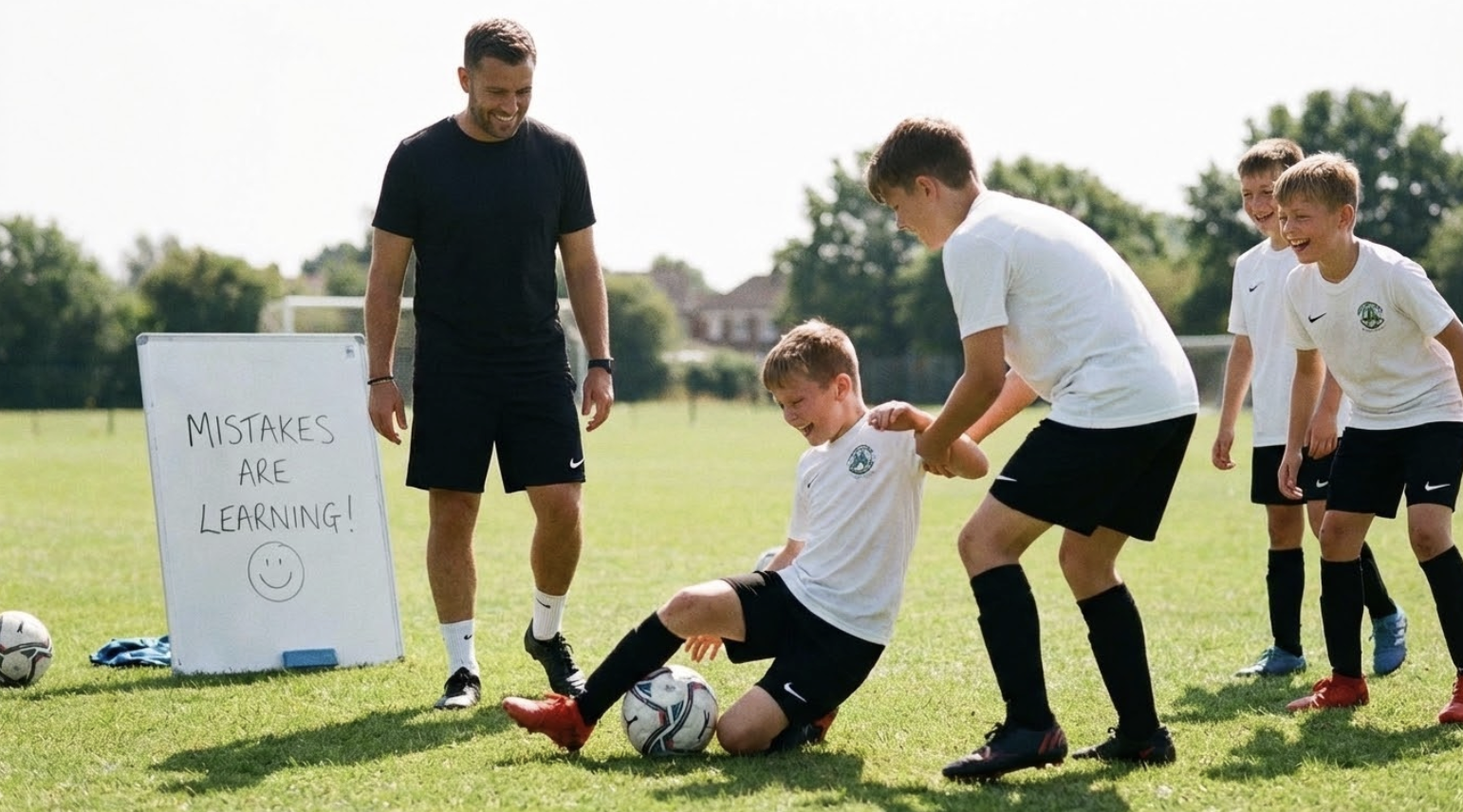
Creating a "Mistake-Positive" Environment in Training Sessions
For coaches, fostering a "mistake-positive" environment where players feel safe to err is paramount. Instead of immediate criticism, coaches should treat mistakes as teachable moments. Implementing "safe zones" in drills, where experimentation is encouraged and consequences are minimised, is an actionable step.
For players, adopting a "growth mindset" is crucial. View errors as data points for player development. Ask: "What could I have done differently?" Seek feedback from coaches and teammates. Regular debriefing sessions, focusing on improvement rather than blame, transforms a team's learning culture, unlocking creative and technical potential.
The Role of Feedback: Turning Errors into Constructive Insights
Effective feedback bridges making a mistake and learning from it. Simply pointing out an error without context helps little. For feedback to be constructive, it needs to be specific, timely, and actionable. "You were too far inside; next time, stay wide to cover the overlapping run," provides clear guidance.
Players must be open to receiving feedback as a tool for growth, not criticism. Proactively asking "What could I have done better?" shows a proactive approach. Encouraging peer-to-peer feedback fosters collaboration. When feedback loops are positive, mistakes quickly convert into concrete insights, accelerating the player's development curve.
Common Misconceptions About Mistakes in Football Development
Dispelling the Myth: "Elite Players Don't Make Many Mistakes"
A pervasive myth in football is that elite players play an error-free game. While top professionals show consistency, they still make numerous mistakes. The key difference isn't absence of errors, but the type of errors, how quickly they learn, and how effectively they recover.
Elite players' mistakes are often subtle, like a slightly under-hit pass. Crucially, they adapt and correct mid-game. A top midfielder's risky pass that fails prompts quick strategy adjustment. Their superior tactical awareness and mental resilience allow them to mitigate error impact, recovering possession or preventing escalation.
Mistakes vs. Laziness: Distinguishing Between Intentional Errors and Poor Effort
It's crucial to differentiate genuine mistakes—part of learning—from errors stemming from lack of effort or focus. A player attempting a difficult pass that fails makes an execution mistake with positive intent. This offers valuable learning opportunity for football player development.
Conversely, failing to track back due to jogging, or misplacing a simple pass from lack of concentration, exhibits poor effort. Expert coaches understand this distinction. Technical/tactical errors with honest effort need constructive feedback. Errors from laziness demand accountability and reinforcing team standards.
Frequently Asked Questions About Mistakes in Football Development
How can a coach encourage players to take risks without fear of making mistakes?
Coaches should explicitly state experimentation is encouraged, especially in training. Implement drills with low consequences for errors and provide positive reinforcement for brave attempts, regardless of outcome. Emphasise learning and growth over flawless execution to build player confidence.
Is there a point where mistakes become too frequent or detrimental?
Yes, a consistent pattern of the same fundamental errors can signal deeper issues like lack of foundational technical skill, poor tactical understanding, or overwhelming pressure. Coaches must intervene with targeted training, breaking down skills, or addressing psychological factors.
How do professional academies incorporate learning from errors?
Professional academies use video analysis and data to systematically review mistakes with players, often one-on-one, identifying patterns. Training sessions are then tailored to address weaknesses, gradually increasing pressure to simulate real game situations and enhance football player development.
What's the best way for a player to recover mentally after a significant mistake during a game?
The "short memory" approach is crucial. Acknowledge the mistake, take a deep breath, and consciously shift focus to the next play using a mental cue. Remind yourself one mistake doesn't define the performance and focus on making a positive impact on the next action.
Can watching replays of my own mistakes actually help me improve?
Absolutely. Video analysis is a powerful tool for learning from mistakes. It allows objective identification of specific errors (e.g., body positioning, decision-making) and their consequences. Reviewing with a coach provides expert insights and actionable steps for faster, more targeted improvement.
Final Thoughts: The Unseen Architect of Football Excellence
In the relentless pursuit of football excellence, the path isn't a flawless ascent. The true narrative of every great player is punctuated by countless errors and misjudgments. These are not roadblocks, but unseen architects building skill, resilience, and tactical intelligence.
Embracing mistakes means adopting a robust learning mindset. Every misplaced pass, missed tackle, or strategic miscalculation is a golden opportunity to gather data, adapt, and return stronger. For players, this means shedding fear and daring to experiment; for coaches, fostering an environment where learning triumphs over perfection.
So, as you step onto the pitch, or watch from the sidelines, remember that the true measure of player development isn't how few mistakes are made. It's about how much is learned from each one, fueling your journey. Embrace the errors, analyse them keenly, and let them build your resilience. The greatest triumphs often begin with the courage to make a mistake. Unleash your potential by understanding the power of imperfection in football.